
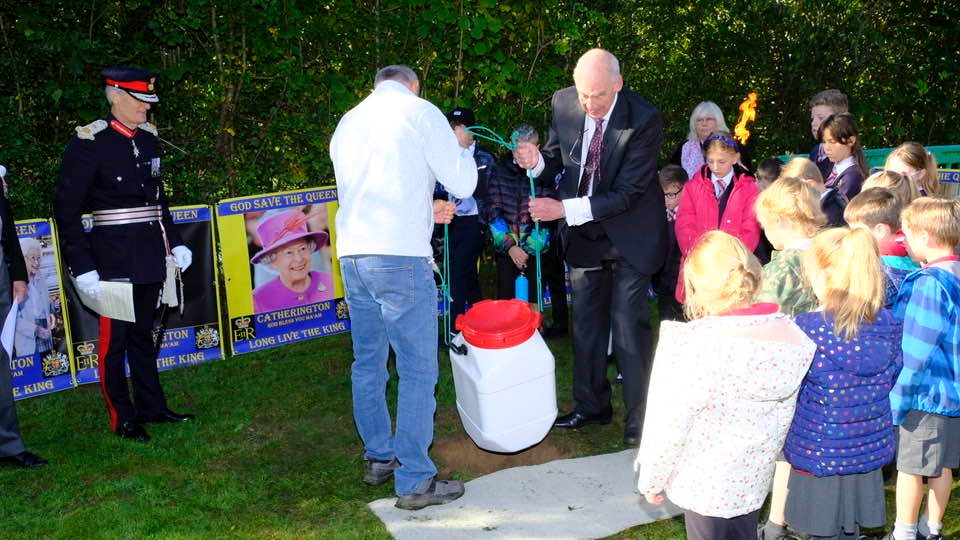
The CVRA assembled a ‘Time Capsule’ that was buried in Old School Field, Catherington Lane ( opposite the Village Pond ) at 10:00 on Tuesday 11th October 2022.
The ceremony was attended by HM Lord-Lieutenant of Hampshire, Mr. Nigel Atkinson, the Queen’s representative in the county.
Children from Catherington Infant School, Kingscourt School, and Horndean Middle School also attended.
A photo and video gallery of the interment of a time capsule – for extraction in 75 years !!
The video also has subtitles as well as a full transcription.

Sue Hodgen´s Speech at the Time Capsule Event
Transcription
I remember listening to the King’s Funeral on the wireless when I was very little. I moved with my family here at Michealmas 1948. My father was actually in the Navy and a naval chaplain.
My mother already loathed the Royal Navy, everything in it and everything about it. He loved it. Catherington Lane was narrow, winding, tree-lined with several farms.
Starting at the top there was Causeway Farm. Then there was the barracks, rumoured to be a hideout during the Civil Wars, a Royalist hideout, backed up by the fact that in All Saints Church there were cannonballs which were said to have dropped off something on its way to destroy something. There were, then there was, I mean the farms weren’t, I mean and now Horndean Community School is built on the top of the barracks.
Then there was Randall’s Farm, Parsonage Farm, Kinch’s Farm, White Dirt Farm. Somebody bred prize-winning jerseys up at Hinton Manor. A lot of farming.
Now then, you won’t believe this, the cows from Kinch’s Farm used to walk up the village at about half six, seven o’clock in the morning, or down the village, they lived on Tarbury which was where All Saints Car Park is now and the Vicarage. They walked through the village to Kinch’s Farm where they were milked and they were brought back just in time for us to walk through it all on our way to school. They did the same journey at four o’clock in the afternoon, both occasions were during the rush hour.
Imagine it now. In the village then we had shops. We had a butcher who delivered two or three times a week.
Fish came on Fridays. There was a post office, a wool shop, newsagent, Queensferry stores at the top of White Dirt Lane where my mother used to put an order in, most of which my father complained was cat and dog food. We had buses going through the village, one to Petersfield, one to Southsea, on the hour and brought us back.
St Michael’s Convent collected the laundry for us and returned it a week later, all starched, cold and crispy. And we had Dick the blacksmith living in the old forge. He was an absolute star for some of us and he could hand forge a set of shoes for your pony and it would cost a pound all round.
He also repaired farm machinery and a gardening kit. Milk was delivered daily, rubbish collected from your back door with the lid returned on top to your back door. The main employer in the village was probably Mrs Long who lived in St Catharines and all these cottages from St Catharines to here housed her employees.
There was a gardener who lived in St Catharines cottages and another groundsman. There was a butler, a coachman, a cook. The laundress lived at this end of Tudor cottages and when that was sold years later the garden was full of mangles and dolly pens.
Mrs Long was, I remember she was lovely, but the stables and the coach house were still painted in her husband’s racing colours which I think were bluey green and white or yellow when St Catharines cottages were sold. So it’s all there, or it was. Major Clark Jarvis was the other landowner around here and he owned everything Mrs Long didn’t I think basically.
All the dads worked, in my recollection, they were either in the Royal Navy, worked in the dockyard or Gale’s Brewery. A lady in Glamorgan Road used to make our best frocks, sailor dresses. Noises we didn’t hear, we don’t hear now anymore, they used to check the air raid warning sirens which used to make the most terrible noise.
We’d hear ship’s foghorns in the Solent and the other noise was Dick while he was hammering and forging iron to make shoes. For entertainment we were always taken to the Pantomime of the Kings, Guy Fawkes Nights, Christmas parties at HMS Mercury, musical happenings at Cadlington Hall and Gilbert and Sullivan and Denmead, church bazaars at Christmas, summer fates, parish breakfasts and village hops, usually in aid of All Saints Church restoration funding. All was crumbling and the vicar and his wife actually organised, which is slightly after I was very little, a Hungarian family to come.
They organised the employment, a house, children’s schooling and it was in the old school in Clanfield and they stayed forever. Life was very gentle and simple at home with cats, dogs being read to, going for walks and really no contact at all with other children because nursery schools hadn’t been invented. However, all that changed in September 1951 when I was taken down the village carrying a satchel containing a slice of fruitcake, pencil case and introduced to Catherington Church of England School’s version of Miss Trunchbull.
She was fearsome and was the infant’s teacher. All of us walked to school from Hinton Manor, from the Downhouse Road, up White Dirt Lane, from Horndean, Five Heads Road, everybody walked. There were two classrooms in school, one for the infants where we all sat in rows, the blackboard, the pointer used for hitting us with, believe it or not, a piano, a fire with a crate of milk, a third of a pint things of milk which they left on there to warm, a wireless which is important and a piano.
The other classroom was bigger but divided into two by a curtain. Seven to nine year olds sat one side of the curtain and nine to eleven year olds sat the other. Lunch was cooked on the premises and cost one and eleven pence per week, that is four pence for a whole week of freshly boiled vegetables, potatoes and slabs of mystery meat and tin prunes or semolina and rhubarb and custard but it was all fresh.
Great. The day started when the bell rang, we weren’t allowed in before the bell rang, we sat in rows, the register was called, Mrs Pitts thumped the piano, we stood up, we sang a hymn, then a prayer, reading, writing and arithmetic followed, scripture, all was about Abraham it seemed to me and every day we had to recite our tables. In fairness, the only part of maths that I’ve ever been certain I could do.
Occasionally we listened to the wireless for music and movement, don’t know what movement involved or went for nature walks. Nobody was allowed to talk or ask questions. We would all answer or speak when spoken to and we had to go to the loo on command, in other words she would suddenly announce we all had to go and that’s what we did, across the yard in all weathers.
A doctor and a nurse and a dentist came and checked us for nits and how we were growing and then on February 6th 1952 King George the sixth died and on the day of the funeral we all sat and listened in total silence to a voice which may or may not have been Richard Dimbleby describing and explaining this momentous event on the wireless as we listened to the solemn military music, horses hooves, muffled drums and slow marching in the background. As little children I doubt that any of us would have believed that his daughter Princess Elizabeth would be our queen for the next 70 years and certainly no concept of the enormous changes that have occurred not only in Catherington but the whole world, moon landings, computer technology and huge advances in medical science to name just but a few. Hence today our burying of a time capsule recording approximately 70 years of change.
It is our sincere hope that at least one or if not some of you will be here to dig it up in 2092 and remember the lives and times of Catherington as it is now. As for me I remember the past with great fond memories. We had a wonderful time and the future should be wonderful for all of you.
Just remember it’s quite easy and the most difficult thing, just love one another. Thanks.