

All Saints Church, Catherington
HISTORY
There are no traces of an earlier building on the site but it seems probable that a Saxon wooden structure did exist. The present church is medium-sized and was probably largely built by Henry de Blois, Bishop of Winchester, during the late twelfth century.
It was originally a rectory but in 1292 Bishop John de Pontissara decreed that on the death of the existing rector it should be converted to a vicarage and the tithes go to Nuneaton Abbey who held the patronage. The Abbey presented the vicars until the Dissolution when the advowson passed to the Crown and was granted by Edward VI to the Bishop of Winchester in 1551. It was regained by Elizabeth I and after 1590 granted or sold to various individuals. It is now vested in the Bishop of Portsmouth.
EXTERIOR
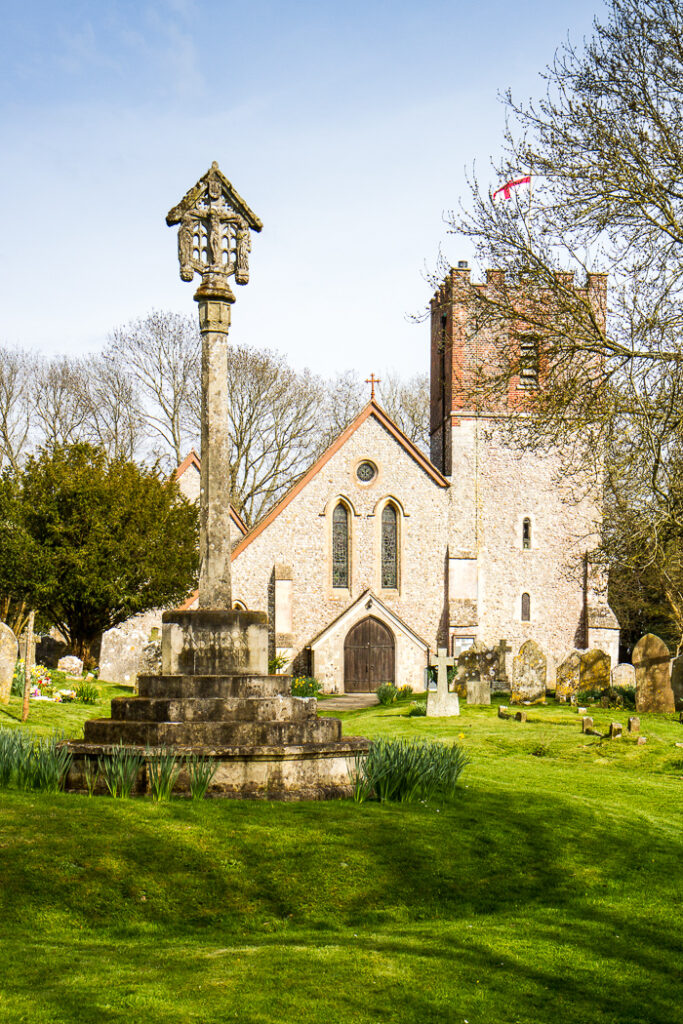
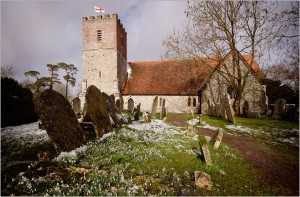
The approach to the Church is from the west, though the south view is more dramatic. The walls are mostly Norman and of local flint and pebble re-faced at the 1883 restoration. The base of the massive south west tower is also Norman
and has small round-headed lights on the ground and first storeys while the top is of red brick with a battlemented edge. It was added in 1750 to take a peal of five bells and another was added in 1887 to commemorate the Golden Jubilee of Queen Victoria. A faculty has been obtained to add a further two bells to the tower to complete the octave. Whites of Appleton are to do the work and the bells will be cast at the Whitechapel Bell Foundry. Until 1963 a small lead
covered cupola topped the tower. The flagpole was added in 1995 in memory of the late Mrs. Eve Evershed.
The nave roof is steep and runs down over the aisles but the north and south chapels are under separately pitched roofs. Near the fine mediaeval south doorway a mediaeval Mass dial can sometimes be seen, depending on the light conditions. The main entrance is through the west door via the porch that was added in 1988, replacing that shown in pictures prior to the 1883 restoration.
THE NAVE
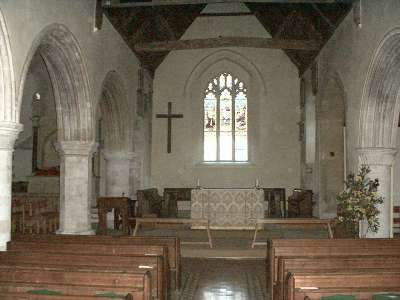
The splendid timber roof with tie-beams is probably of the fourteenth century and covers both nave and chancel; there is no chancel arch or clerestory. On either side are arcades of Norman columns, those on the south side are round with
simple scalloped capitals while those on the north side, alternately round and octagonal with moulded capitals, are probably of slightly later date. They support deeply cut moulded round arches.
On the north wall is a much-restored painting of about 1350 “the finest… in Hampshire” (Tom Beaumont James, The Black Death in Hampshire, page 15) – depicting St. Michael weighing souls. The archangel is vigorously drawn with outstretched wings and holding an upraised sword in one hand and a scale in the other. From one end a bundle of souls is suspended and a demon with curly tail is trying to weigh down the beam to condemn them to damnation. But the Virgin Mary is standing near the other end of the beam. holding it to save the souls from being weighed down and carrying another soul for assessment.
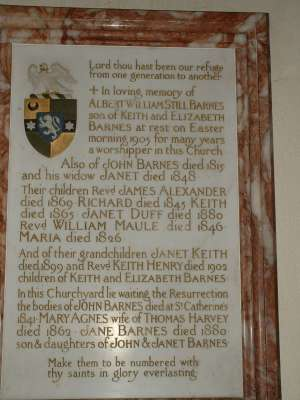
Lord thou has been our refuge from one generation to another In loving memory of ALBERT WILLIAM STILL BARNES son of KEITH and ELIZABETH BARNES at rest on Easter morning 1905 for many years a worshipper in this Church.
Also of JOHN BARNES died 1815 and his widow JANET died 1848. Their children Revd JAMES ALEXANDER died 1869. RICHARD died 1845, KEITH died 1865 JANET DUFF died 1880 Revd WILLIAM MAULE died 1846 MARIA died 1826.
And of their grandchildren JANET KEITH
died 1899 and Revd KEITH HENRY died 1902 children of KEITH and ELIZABETH BARNES.
In this Churchyard lie waiting the Resurrection the bodies of JOHN BARNES died at St Catherines 1841. MARY AGNES wife of THOMAS HARVEY died 1862 . JANE BARNES died 1880 son & daughters of JOHN & JANET BARNES.
Make them to be numbered with
they saints in glory everlasting.
Beneath it is a marble tablet to members of the Bames family and opposite it a brass plaque to Jane Barnes of St. Catherines ‘to whose munificent bequest of one thousand pounds the restoration of the church is mainly due. 1883′.
The west doorway is of thirteenth century date, and has glazed doors added in 1989. Above it is a window of two lancets. The glass is in memory of William Pink. J.P. (d.1906) and his wife Charlotte Ellen (d.1882) and depicts John the Baptist pointing to Christ as the Lamb of God below which are smaller scenes of John preaching and the Baptism of Christ. The small round window above has a vigorous image of the Holy Spirit as a dove poised to descend.
In the short SOUTH AISLE are two windows, each of two separate lancets and deeply set in the thick late Norman wall. The glass is undistinguished and represents the Presentation of Christ in the Temple and the Boy Jesus and Doctors of the Law. They were presented in memory of two former parishioners. Between them is a board giving the list of incumbents of Catherington since 1306.Under the tower is the clergy vestry where wood from the pulpit (cl883) has been re-worked to form seating.
Crossing to the NORTH AISLE we find, at the west-end, the choir vestry created by a wooden screen to the east and decorative pipes from the (defunct) Hunter organ in an arch dating from the 1883 restoration. In its west wall a single lancet illustrates the scene ‘Blessed are the pure in heart for they shall see God.’ It
commemorates William Friend of Hartplain (d.1877) and Ann, his wife (d. 1899). The choir vestry also encloses a double lancet window of The Marriage at Cana. In the aisle is another double lancet window depicting the Light of the World in one light and the Good Shepherd in the other. Both were given as a thank offering for recovery from illness in 1902. The church’s Memorial Book rests in this windowsill.
At the east-end is one of the church’s treasures, a fourteenth century churchyard cross. It was discovered in 1882 when the path outside the west door was being
repaired. The base (now in the Hyde Chapel) had been found some years previously beneath the tower and had been built into the northwest comer of Hyde Chapel. The cross itself was then also erected there but in 1925 was moved to its present position. The material is an unusual hard green limestone. On the head is a badly eroded carving of a crucifix between St. Mary and St. John.
Close to the chancel stands a wooden lectern (cl883).
THE CHANCEL
The east window has a thirteenth century surround with thin internal mouldings and shafts but a small perpendicular window has been inserted within the frame. The glass is Victorian and depicts the adoration of the Virgin and Child. The
plain panel at the base was formerly covered by a reredos (cl883) that was damaged by damp and removed during a re-ordering of the sanctuary in 1982. The alterations increased the depth of the sanctuary and were in memory of Frances Isabel Gale of Dandenong, Victoria, Australia. To the right of the altar is a small fourteenth century piscina, and above it a window showing the Supper at Emmaus and the Risen Christ with Mary Magdelene which commemorates the parents of Rosalie Whalley-Tooker.
On the wall to the left of the altar are some memorial tablets, among them to John Williams, Vicar of the Parish for thirty-eight years (d. 1778) and to Roger Curtis, a captain in the Royal Navy who died at the age of twenty-two in 1802. His parents are commemorated on the wall opposite
The 1990s re-ordering opened up the chancel for worship and other events by removing the wooden screen that formerly divided the chancel from the nave, moving the choir stalls east and the altar onto a central platform. The uncluttered lines emphasise the centrality of the altar and allow the Eucharist to be celebrated clearly and visibly. New servers stools have been made from redundant pews and all the chancel furniture is portable in the interest of flexibility.
Below it stands the splendid canopied tomb of Sir Nicholas Hyde and his wife (1631). “A fine monument of the period” (Pevsner & Lloyd, Buildings of England, Hampshire & IOW, page 160).
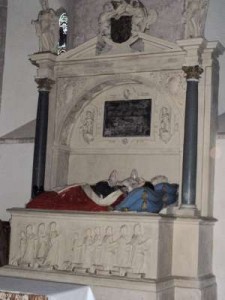
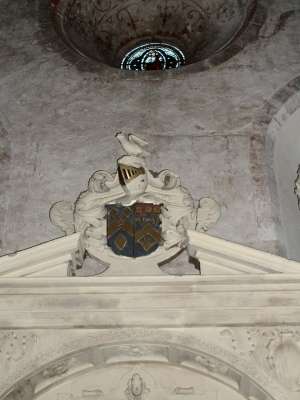
They lie in effigy on a table-tomb, their hands in prayer and heads resting on sumptuous tasselled pillows. He wears a ceremonial black cap over the ‘Coif’ of a serjeant-at-law, the scarlet and ermine robe of a judge and round his shoulders, the golden collar of the Chief Justice of the King’s Bench. Above them is a rounded canopy with panelled under-side, scrolls and cartouches in the spandrels, a gilded inscription on a panel and over that an entablature and broken pediment supporting a coat-of-arms. The shield is divided and shows on the left, Hyde differenced with a red mullet, indicating that Sir Nicholas was a third son, impaling on the right the arms of Swayne. It is surmounted by a helm and mantling and the eagle crest of Hyde.
On either side prominent columns of marble with Corinthian capitals support the figures of Justice and Wisdom. Small childlike figures of Time and Death are shown at the back of the canopy. The children are represented on the front of the table-tomb itself.
Passing through the north arch from the chancel, one enters the HYDE CHAPEL, a lofty mediaeval extension, once probably used as a Lady Chapel. The west wall has a number of memorial tablets mainly to the Napier and Cherry families (relatives of Admiral Sir Charles Napier.) On the north wall is a pair of double windows, the first depicts two healing miracles from the Acts of the Apostles, the second Jesus raising to life the widow’s son at Nain and Lazarus at Bethany.
On the east wall are two narrow lancet windows depicting St Matthew, St Peter, St John and St Mark, St Paul and St Luke. The circular window in the gable above them shows Christ in Majesty. The frame is decorated with patterns in red, probably of the same period as the St. Michael fresco.
Hyde came from the Wiltshire branch of this family and acquired the manor of Hinton Daubnay in the parish at his marriage to the daughter of Sir Arthur Swayne. He was a barrister, successively MP for Andover and Christchurch and defended the Duke of Buckingham at his impeachment, rising rapidly in favour with Charles I. He was knighted and created Chief Justice of the King’s Bench early in 1627, presiding over a number of interesting cases before his death from gaol fever on 25th August 1631. He was described as of mean appearance and careless of his dress, riding on circuit in a whitish-blue cloak “more like a clothier or a woolman than a Lord Chief Justice’ and lowering the dignity of his office. His son, Lawrence, lived in the parish for many years and took a prominent part in planning the last stage of Charles II’s escape to the continent after his defeat at the battle of Worcester in 1651. Their descendants, the Whalley-Tooker family, continued at Hinton Daubnay until recently and are commemorated in the church. Edward Hyde, Earl of Clarendon (1609-1674), distinguished historian and Lord Chancellor to Charles 11 after the Restoration, was a nephew of Sir Nicholas.
In the Hyde Chapel is the Alien Computer organ purchased in 1989. It replaced a two-manual pipe organ built in the 1860s by Alfred Hunter of London for Merchistoun Hall and donated to All Saints in 1882. In the 1970s it was vastly enlarged and given prototype electronic action that made repair impractical. However, the Parochial Church Council has retained the pipework should it prove desirable to rebuild the Hunter organ at a future date.
Crossing the chancel we enter the SOUTH TRANSEPT OR LADY CHAPEL added to the church in 1883 as a choir vestry and to house the Hunter organ. The fifteenth century window over the altar was moved from the former chancel south wall which is now pierced by an arched opening. The painting is a copy of Titian’s ‘Descent from the Cross’ in the Louvre and was originally set in the centre of a reredos in the chancel. In the east wall is a square-headed window of
two trefoiled lights of about 1340.
The Blessed Sacrament is reserved in the Lady Chapel for communicating the sick at home or as a focus for devotion.
The FURNISHINGS are almost all of the 1883 restoration, whose architect was Edmund Ferrey.
The PLATE includes a cup given by Lawrence Hyde in 1660 and engraved with figures of the Good Shepherd and a Paschal Lamb and a decorated paten dated 1663.
ALTAR FRONTALS in green, violet and red given in 1913 are still in use, mainly on the Hyde Chapel altar. The latter came from Catherington House when it was the Portsmouth Diocesan Retreat House. The church also has white and blue frontals and a Laudian cloth in red and gold. A recent in memoriam bequest enabled the PCC to commission new frontals in green, white and Lenten array – the latter with a crown of thorns symbol designed by Canon Douglas Snelgar.
The VESTMENTS include a white cope and chasubles in green, violet, red and white. The in memoriam bequest also enabled the PCC to commission High Mass sets (vestments for the priest, deacon and sub-deacon) in green, red, white, blue and Lenten array. The new frontals and vestments are mainly the work of Mrs. Grace Holt, assisted by other ladies of the congregation.
The REGISTERS of Baptisms 1602-1960, Marriages 1602-1998 and Burials 1602-1900 are deposited at the City Records Office, Museum Road, Portsmouth. Current registers are in the care of the incumbent.
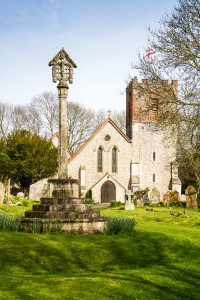
THE CHURCHYARD
The churchyard is large and surrounded by tall trees. It is entered through a lychgate that is the village War Memorial. After much controversy Mr Romney Green’s design was agreed upon and the lychgate dedicated by the Bishop of Winchester on 24 August 1921.
A grassy path leads up to the church encircling on the way a Cross which is a monument to Rear-Admiral Sir Christopher Cradock, killed in action on All Saints Day 1914 in a battle with superior German forces at Coronel off the Chilean Coast. It also commemorates the Barnes family.
Tucked away among trees northeast of the church is the tomb of Admiral Sir Charles Napier, known as ‘Black Charlie’ (1786 -1860). An adventurer, he became involved with a revolution in Portugal, commanded land forces in the defence of Lisbon and then took control of the Portuguese fleet with which he destroyed the rebel squadrons on July 5th 1833. He was later struck off the British Navy list but restored t.o his former rank in 1836. He commanded the Channel fleet and later the Baltic fleet during the Crimean War (1854) where he again lost popularity after disobeying orders to attack Cronstadt. He was MP for Southwark from 1855 until his death at his Horndean home, Merchistoun Hall, in 1860. He was a well known figure in the district, clad in a smock to identify himself with the local inhabitants ‘about 14 stone, stout and broad built; stoops from a wound in his neck, walks lame from another in his leg, turns out one of his feet and has a most slouching, slovenly gait; a large round face with black, bushy eyebrows, a double chin, scraggy, grey uncurled whiskers and thin hair; wears a superfluity of shirt collar and small neck-handkerchief, always bedaubed with snuff – usually his trousers far too short and wears the ugliest pair of old shoes he can find’. (DNB)
Another well known tomb is that of three members of the family of Edmund Kean, the great tragedian, his wife, and son Charles John and daughter-in-law. Ellen Tree, the actress. Charles (1811-1868) was an enthusiastic antiquarian but reluctantly followed his father as a Shakespearean actor and theatre manager. He was ‘a careful and conscientious but scarcely inspired actor with an abundant stock of mannerisms and vicious style of pronunciation’. His ‘Henry VIII’ in 1865 was said to be memorable. The sarcophagus stands to the east of the chancel.
There is also a touching memorial to the six children of a local family, all of whom died before they were eight years old. To the east of the south door there is a coffin slab, engraved with a long foliated cross, which is probably of fourteenth century date.
Follow the footpath south of the church (once the site of two great yew trees, planted in 1729, but felled due to storm damage in 1987 and 1990 and now replaced by flowering cherry trees). Through the gate is an ancient meadow known as Turbary (or Tarbery) where, in the Middle Ages, villagers had the right to cut turf for fuel. The delightful view looks north towards Windmill Hill (633 feet) and south towards modem Horndean.
(Text from “CATHERINGTON:The Church&Village” a Visitors Guide by Christopher Beardsley, Vicar)